When fiber optics reach their limits-
where wireless fiber can be a fast and economical solution.
Fiber optics are considered the future-proof infrastructure for high-performance broadband networks. Nevertheless, there are situations where traditional fiber optic deployment reaches its limits. The challenge is not a lack of bandwidth, but rather high excavation costs, complex permitting processes, or local conditions that hinder a fast connection.
Whether rivers, railway lines, industrial and factory sites, historic city centers, or difficult-to-access areas – a fiber optic connection cannot be implemented everywhere with reasonable effort . Time can also be a crucial factor when it comes to the rapid restoration of critical infrastructure.
Wireless fiber (free-space optical transmission, FSO) can also make a significant contribution to network resilience. If existing connections are interrupted, for example, by construction work, natural disasters, or technical defects, high-performance replacement links can often be deployed much faster than new wired connections. This allows critical communication links to be activated as backup connections at short notice, configured redundantly, or quickly restored after a failure. This increases reliability and supports continuous business operations even during disruptions.
Furthermore, wireless fiber solutions are suitable for temporary bandwidth requirements. At trade fairs, concerts, festivals, or large sporting events, locations can be connected at short notice without having to implement extensive infrastructure measures first. After the event, the connection can be flexibly dismantled if needed or reused elsewhere.
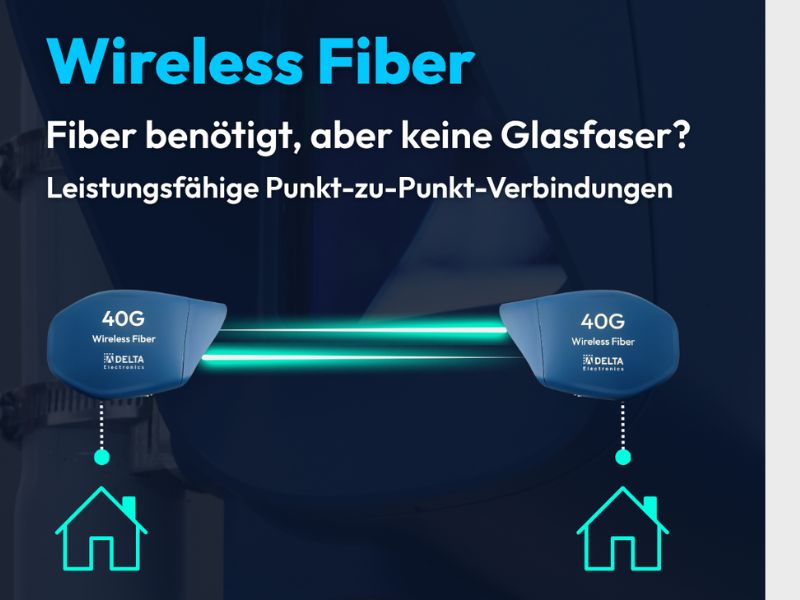
Wireless fiber (free-space optical transmission, FSO) is becoming increasingly important for precisely these kinds of applications. Data is transmitted not via a fiber optic cable, but using a laser-based line-of-sight connection between two locations. This technology does not replace fiber optics – it complements them where traditional fiber optic solutions reach their limits or are not economically feasible in the short term.
practical example
A simplified practical example illustrates the difference.
If an administrative building needs to be connected to a production hall on a factory site, an underground fiber optic connection can require excavation work, permits, and corresponding construction time, depending on local conditions. If there is a clear line of sight between the two buildings, a wireless fiber optic connection can often be implemented much faster. The actual time and cost savings naturally depend on the specific circumstances – however, this example shows that not every connection necessarily requires excavation.
Transfer rates
Modern laser-based FSO (Wireless Fiber) systems have established themselves as a powerful complement to classic fiber optic connections and now enable reliable point-to-point connections with transmission rates of up to 40 Gbps.
The decision for or against wireless fiber is therefore not a fundamental choice between two technologies. Rather, the question is which solution offers the greatest technical and economic benefit for the specific application. In many cases, traditional fiber optics remain the first choice.
Conclusion
However, where time, effort or local conditions make expansion difficult, wireless fiber can represent a powerful and economical addition.
DELTA Electronics helps you identify the appropriate and economical solution for your individual requirements.